Wednesday, July 17, 2013

What if the photo at Iwo Jima was staged?

When you gather pictures for the church directory or write up a bulletin article asking people to participate in the soup kitchen meal prep you are in many ways mediating your ministry. Like the media does.

You are portraying something that is or something that you hope is or something that you want to become. Like the media.

What if I told you the photo of the flag raising at Iwo Jima was staged?

When I first heard that, I was incensed.  The photo represents to me a turning point of the war. A moment when good overcame evil.

I'm really not sure if the photo was staged or not.

I have learned some a few things about the flag raising at Iwo Jima.

The photo was taken before the battle: not after. Many of the men pictured in it were killed in the battle.


There were several photos taken of the flag and at least one was staged or posed.
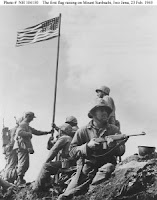


There were two raising of the flags.  The photo of the first one wasn't very inspirational to look at.


And none of it really matters in terms of what the photo means to me as an American.

It's about good overcoming evil.

Some of the pictures in your directory or the stories of you ministry may or not be staged.

Some of the stories I read in the Bible may or not be historically accurate.

And none of it really matters in terms of what those pictures or stories mean to me as a person of faith.

It's about love overcoming fear.

The way in which we are made by as we participate in the sharing of our faith touches in some way every thing we do. Our context, our history, our scriptures, and our experiences.  Do they lead us closer to God and to each other?  How we embrace that and each other is what really matters.

Saturday, July 6, 2013

How to deal with deviants

de·vi·ant  

/ˈdēvēənt/
Adjective
Departing from usual or accepted standards, esp. in social or sexual behavior.
Noun
A deviant person or thing.


W.I Thomas noticed that "Things which men perceive as real are real in their consequences."

In mission and ministry with the groups of people who have something (let's say us) and those who don't (let's call them deviants) we sometimes stop at attempts to economize how to best get the stuff that we have to the people who don't.

If we take a step further or take a step back, we might try for a moment to understand these deviants.

The homeless, I was told by a homeless person, wish sometimes that people would "quit trying to figure out homeless people."

What we think of deviants often comes from news sources, friends and family, and our pew and Sunday school seat.

Our perceptions of deviants are mediated by the media of our ministry.

In this scene from West Side Story we get the idea that these deviants are missing something that can be provided by the right resource.

The troubles of the deviants are seen as systemic and sociological.  But our troubles occur individually as well.

What we often think of the deviant (you can substitute homeless, poor, unbeliever, fundamentalist, liberal, or any "they are wrong to my right" label you wish) comes from news, theology, or religious beliefs that we figure are just "showing it as it is".

And the fact is that they are all wrong.

Wrong for a reason.

They might even be wrong for good reason.  For earnest, committed, Biblically based reason.

When a member of a church focus group heard some of our ideas about developing ways to get to know some of the folks we minister to on a personal level and then help each other get to know our abilities and gifts that we can bring to the community development table, she remarked "you better check with the mission people about that."

As in maybe the mission people wouldn't like that? Because the mission people had different reasons?  Like getting people on board with a belief system that would make it so that they could get to heaven too. Like us. Like me!

In reality the mission people, if this is their reason, know this is wrong and the people in the focus group know it's wrong, but we seem to have this understanding that we are wrong and the people in our congregations know we are wrong, but we both have a role to play and we are doing it for the right reason (in this case salvation.)

The way to discipleship might lead through coming to understand what these good reasons are for this wrong way thinking.

How do we interpret each other's experiences and beliefs so that we can get to know each other and God?

It might start with trying to get to know the deviants before we try to understand them, much less fix them.

How to deal with deviants?

Make sure you know some.

Thursday, February 21, 2013

4 Choices you have when under stress

Stress for the purposes of our discussion is being in a position to do something that you don't want to do.  In this moment, you would literally rather be somewhere else.

Most of the time we have at least four choices when under stress:

1. Do it because you decide you are going to be in this place in order to see what you can learn from it.  Is there a different outcome you will discover that will lead you to a different, if not better place?  This is basically the opposite George approach.  "If every instinct you have is wrong, then the opposite would have to be right."

2. Do it because, although you see it as a waste of time and beneath you, you know that it is important to someone else and therefore "making them happy will make me happy."  Jin up your energy, punch the time clock, put on a smile and do the work well.

3. Don't do it and be OK with that because you just weren't in the right place for it at the moment.  You earn the ability to take this option most likely after you have successfully employed option 3 a a time or two.  There is nothing wrong with paying your dues to be able to say no.  Consider this option also partly as a time to build up the reserves to take option 2.  Options 2 and 3 might be considered as a bank account.  Option 2 is deposits.  Option 3 is debits.  Try to build up some savings.

4. Do it and resent it.  This is often the option we take most when we don't consider the other alternatives.  But it is an option we should try to avoid at all costs.  Because it costs more than it is worth. It drains any hope of joy.  It bankrupts any capital we have. It creates negative energy and puts us behind the next time we have a choice to make.

The challenge? Developing the wisdom of when to employ which option.

I recently read a story about a doctor who took the time to help a patient eat her food, spruce up her pillow, and empty the bed pan for her.  I must admit it was counter intuitive to me.  It seemed like a rare thing for a doctor to do these things.

I asked a health care professional why it seemed so out of the ordinary.

They usually don't, she said, because they are so busy.  They are under a lot of stress.  They have forgotten that doing these little things for a patient are joy.

As a leader in discipleship, we are busy and under stress.  Have we forgotten about joy?

Maybe being wise in moments of stress will lead us back to the moments of joy that got us into this work in the first place.

Choose wisely my friend.

Find joy.

Thursday, December 20, 2012

Atonement for All of Us

I'm a little fuzzy on atonement.  Or Atonement.

And maybe that's it.  I'm unsure of the relationship between atonement- making amends for our wrongs, missteps, and sins- and Atonement-what Jesus did for us and in fact the whole world.

Jesus came to take on the wrongs, missteps, and sins of the world.

But we still are expected to atone for our wrong doing- confession, asking for forgiveness, and reparations.  In the court room and around the kitchen table.

But are we, as a part of our journey toward Christlike-ness asked to make up for, or own up to, the wrongs, missteps, and sins of others?

Some people say we do that for our children and for those closest to us.

But how about the world.  Did God so love the world that he sent me?

If so, how might I live that out:

  • Giving money to the homeless guy instead of offering to buy him some food and watching him eat the food.
  • Taking the blame for a committee chair screw up at the staff meeting. (Not because taking the blame and giving the credit is good "leadership", but because I am atoning Jesus style.
  • Allowing someone who has a physical disability on the mission team even though you won't be able to accomplish as much because you will spend so much time helping them.
  • Volunteer time to a cause that you don't believe in.
  • Letting someone explain something to you that you frankly understand better than they do.
  • Not explaining about how right you are about a decision that the group makes without your blessing.
  • Letting someone espouse a theological understanding that is wrong.
  • Listening to someone (like your wife maybe) share their frustrations without trying to fix them (not because you are reading Men are from Venus, Women are from Mars, but because you are atoning.
  • Allowing someone to say Happy Holidays without having to remind them about the reason for the season (especially if the reason for the season is to call us to atonement).
Just a few ideas.  Maybe there are others. 

We learned in Disciple that Atonement can be explained at At-One-Ment with God.  Does taking on the wrongs of others draw you closer to God?

Wednesday, September 5, 2012

The difficulty of deciding when to open the door

There is a memorable scene in the classic movie, Young Frankenstein.

For some reason the character played by Gene Wilder decides that he needs to go into a locked room with the "monster" that he has created.  Things haven't worked out as planned with his creation, and he maybe needs to try to reason with his misdirected efforts at creating a human life.

Before he opens the door to the cell where he has the creature trapped he turns to his assistant and says something to the effect of No matter what I say or do, do not open this door.

Pretty much the second he goes in, the monster becomes enraged and Wilder begins banging on the door and in a very calm tone says, Open this door please.

The difficulty with accountability in ministry, parenting, or discipleship growth is when to hold those we serve in any of these areas to the promises and vows we take; and when to relent.

You can easily find yourself holding the bag (or outside the door of a locked room with a raging monster inside) of the fundraiser, ministry event, small group, or new puppy that someone, some time thought was such an awesome idea.

When to take up the reins of someone else's vision, when to let it die, and how much the monster beats them up before you let them out is one of the most difficult duties of discipleship I have run into.

I guess that is why we find ourselves rushing toward situations that everyone else is seems to be rushing away from.

Which is sounds kind of cool.

But, for the most part: I find myself shouting, "Open this door please!"

Saturday, June 30, 2012

A recent email informed me that there can only be one truth.


...Consider what Jesus said, "I am the way, the truth, the life. No one comes to the Father but through me." If all religions are a valid way to God, then Jesus was not telling the truth. And if Jesus was not telling the truth, He is not the only way. Truth, by definition, means that one statement is true and a contradicting statement is false.

Either Jesus is truth or universalism is truth. What do you believe? I believe Jesus...


Interesting, because I've recently been mulling over how there's more than one truth.

Your truth.

And my truth.

That's at least two truths and the fact is there is at least one truth for every you and for every me.

What difference does it make if you start with the idea that there is only one truth and everything else is false or if there are lots of truths?

For me, it's that one leads to lots of arguments about what Christian is.

The other one leads to discoveries about how Christians live.

I'll have to spend some time with you to figure our if your truth helps me live into the truth of Christ.

And you'll have to do the same.

I'd rather live with you and your truth and find out how it helps (or doesn't) me live a more truthful Christian life.

Than argue with you about what's true and what's false.


Monday, April 2, 2012

Caring for homelessness without caring for the homeless

I was helping prepare a lunch at a soup kitchen one time. On this particular day, a group from an organization renown for its support of the work the soup was doing to serve the homeless was also on the property working on a construction of a new building..

This organization was involved with all sorts of projects with the shelter from construction of facilities to programs.

When it came time to serve lunch, an interesting thing happened.

The workers who took a break to eat their lunch dined alone and not with the homeless folks we were serving.

It got my mind to thinking that it's possible to care about homelessness without really having to become involved with the homeless.

I asked my two daughters about this and sensing the perhaps disdain in my voice as I asked their opinion, they simultaneously responded that "Not everyone is like you. People serve in different ways and that is OK."

I have mentioned the phenomenon to other people.  One said, well when you really analyze it, we really don't do the service work at the shelter for the homeless, we do it for us.

There is no doubt a difference between caring about homelessness and caring about the homeless.

Maybe we prefer to be able to control our involvement and how and when we care about things.

And that's OK, but can we, together, have the courage to serve in a such a way that we can't necessarily control and with the homeless instead of just for the homeless?

Would anything change if we served out of faith?